 Add to Chrome
 Add to Firefox
 Add to Edge
A Simple Plug-in for Improving Eviction-Based KV Cache Compression
May 22, 2026
KV cache growth is a major bottleneck for long-context inference in large language models. Existing methods are often dominated by binary eviction or representation approximation, which may underutilize tokens that are not critical for exact retention but are still reconstructable. We present VECTOR, a plug-and-play augmentation for eviction-based pipelines that introduces three-way token routing: retention, approximation, and eviction. VECTOR combines an importance signal from the base scorer with a reconstructability signal from an offline-calibrated regression-based value estimation. By leveraging reconstructability, VECTOR recovers useful value information that would otherwise be irreversibly lost under binary eviction, while preserving key vectors for attention routing stability. Experimental results show that VECTOR improves quality-memory trade-offs under medium-to-high compression, with especially clear gains in stricter budget regimes.

Crafting Reversible SFT Behaviors in Large Language Models
May 07, 2026Supervised fine-tuning (SFT) induces new behaviors in large language models, yet imposes no structural constraint on how these behaviors are distributed within the model. Existing behavior interpretation methods, such as circuit attribution approaches, identify sparse subnetworks correlated with SFT-induced behaviors post-hoc. However, such correlations do not imply *causal necessity*, limiting the ability to selectively control SFT-induced behaviors at inference time. We pursue an alternative by asking: can an SFT-induced behavior be deliberately compressed into a sparse, mechanistically necessary subnetwork, termed a *carrier*, while remaining controllable at inference time without weight modification? We propose (a) **Loss-Constrained Dual Descent (LCDD)**, which constructs such carriers by jointly optimizing routing masks and model weights under an explicit utility budget, and (b) **SFT-Eraser**, a soft prompt optimized via activation matching on extracted carrier channels, to reverse the SFT-induced behavior. Across safety, fixed-response, and style behaviors on multiple model families, LCDD yields sparse carriers that preserve target behaviors while enabling strong reversion when triggered by SFT-Eraser. Ablations further establish that the sparse structure is the key precondition for reversal: the same trigger optimization fails on standard SFT models, confirming that structure rather than trigger design is the operative factor. These results provide direct evidence that the learned carriers are causally necessary for the behaviors, pointing to a new direction for systematically localizing and selectively suppressing SFT-induced behaviors in deployed models.
ManifoldKV: Training-Free KV Cache Compression via Euclidean Outlier Detection
Feb 09, 2026Long-context inference is constrained by KV-cache memory, which grows linearly with sequence length; KV-cache compression therefore hinges on reliably selecting which past tokens to retain. Most geometry-based eviction methods score keys by cosine similarity to a global centroid, but cosine is scale-invariant and can discard magnitude cues that distinguish semantically salient tokens. We propose ManifoldKV, a training-free scorer that ranks tokens by Euclidean distance to the key centroid, capturing both angular and radial deviations. On the RULER benchmark, ManifoldKV achieves 95.7% accuracy at 4K-16K contexts with 20% compression; matching the best geometric baseline while improving robustness in two regimes where cosine scoring fails. First, on multi-key retrieval, ManifoldKV reduces directional collisions, achieving 92.4% vs KeyDiff's 77.0% (+15.4 points) on 3-key NIAH at 50% compression. Second, to address dilution and performance collapse of global centroids at 64K context, we introduce WindowedManifoldKV, which restores accuracy to 84.3% at 25% compression, a 49-point recovery over global L2 and +3.2 points over KeyDiff. The method requires only 3 lines of code and works across 4 architectures without tuning.
TRAJECT-Bench:A Trajectory-Aware Benchmark for Evaluating Agentic Tool Use
Oct 06, 2025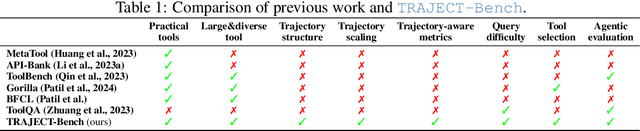
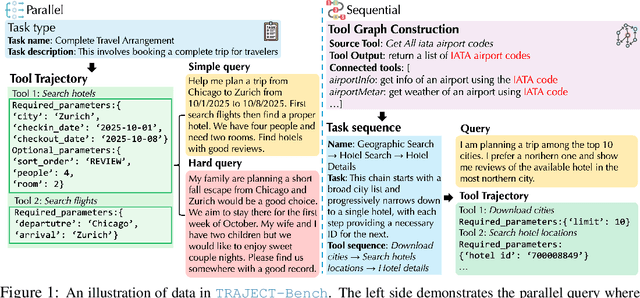
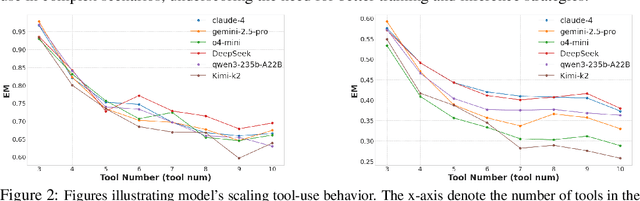
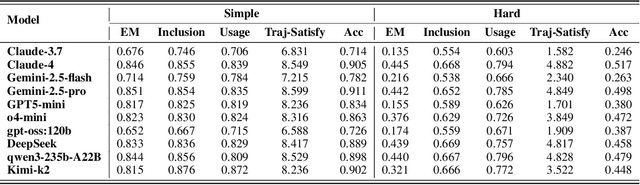
Large language model (LLM)-based agents increasingly rely on tool use to complete real-world tasks. While existing works evaluate the LLMs' tool use capability, they largely focus on the final answers yet overlook the detailed tool usage trajectory, i.e., whether tools are selected, parameterized, and ordered correctly. We introduce TRAJECT-Bench, a trajectory-aware benchmark to comprehensively evaluate LLMs' tool use capability through diverse tasks with fine-grained evaluation metrics. TRAJECT-Bench pairs high-fidelity, executable tools across practical domains with tasks grounded in production-style APIs, and synthesizes trajectories that vary in breadth (parallel calls) and depth (interdependent chains). Besides final accuracy, TRAJECT-Bench also reports trajectory-level diagnostics, including tool selection and argument correctness, and dependency/order satisfaction. Analyses reveal failure modes such as similar tool confusion and parameter-blind selection, and scaling behavior with tool diversity and trajectory length where the bottleneck of transiting from short to mid-length trajectories is revealed, offering actionable guidance for LLMs' tool use.
Retrieval-Augmented Generation with Graphs (GraphRAG)
Jan 08, 2025



Retrieval-augmented generation (RAG) is a powerful technique that enhances downstream task execution by retrieving additional information, such as knowledge, skills, and tools from external sources. Graph, by its intrinsic "nodes connected by edges" nature, encodes massive heterogeneous and relational information, making it a golden resource for RAG in tremendous real-world applications. As a result, we have recently witnessed increasing attention on equipping RAG with Graph, i.e., GraphRAG. However, unlike conventional RAG, where the retriever, generator, and external data sources can be uniformly designed in the neural-embedding space, the uniqueness of graph-structured data, such as diverse-formatted and domain-specific relational knowledge, poses unique and significant challenges when designing GraphRAG for different domains. Given the broad applicability, the associated design challenges, and the recent surge in GraphRAG, a systematic and up-to-date survey of its key concepts and techniques is urgently desired. Following this motivation, we present a comprehensive and up-to-date survey on GraphRAG. Our survey first proposes a holistic GraphRAG framework by defining its key components, including query processor, retriever, organizer, generator, and data source. Furthermore, recognizing that graphs in different domains exhibit distinct relational patterns and require dedicated designs, we review GraphRAG techniques uniquely tailored to each domain. Finally, we discuss research challenges and brainstorm directions to inspire cross-disciplinary opportunities. Our survey repository is publicly maintained at https://github.com/Graph-RAG/GraphRAG/.
RED QUEEN: Safeguarding Large Language Models against Concealed Multi-Turn Jailbreaking
Sep 26, 2024


The rapid progress of Large Language Models (LLMs) has opened up new opportunities across various domains and applications; yet it also presents challenges related to potential misuse. To mitigate such risks, red teaming has been employed as a proactive security measure to probe language models for harmful outputs via jailbreak attacks. However, current jailbreak attack approaches are single-turn with explicit malicious queries that do not fully capture the complexity of real-world interactions. In reality, users can engage in multi-turn interactions with LLM-based chat assistants, allowing them to conceal their true intentions in a more covert manner. To bridge this gap, we, first, propose a new jailbreak approach, RED QUEEN ATTACK. This method constructs a multi-turn scenario, concealing the malicious intent under the guise of preventing harm. We craft 40 scenarios that vary in turns and select 14 harmful categories to generate 56k multi-turn attack data points. We conduct comprehensive experiments on the RED QUEEN ATTACK with four representative LLM families of different sizes. Our experiments reveal that all LLMs are vulnerable to RED QUEEN ATTACK, reaching 87.62% attack success rate on GPT-4o and 75.4% on Llama3-70B. Further analysis reveals that larger models are more susceptible to the RED QUEEN ATTACK, with multi-turn structures and concealment strategies contributing to its success. To prioritize safety, we introduce a straightforward mitigation strategy called RED QUEEN GUARD, which aligns LLMs to effectively counter adversarial attacks. This approach reduces the attack success rate to below 1% while maintaining the model's performance across standard benchmarks. Full implementation and dataset are publicly accessible at https://github.com/kriti-hippo/red_queen.
Hybrid LLM: Cost-Efficient and Quality-Aware Query Routing
Apr 22, 2024Large language models (LLMs) excel in most NLP tasks but also require expensive cloud servers for deployment due to their size, while smaller models that can be deployed on lower cost (e.g., edge) devices, tend to lag behind in terms of response quality. Therefore in this work we propose a hybrid inference approach which combines their respective strengths to save cost and maintain quality. Our approach uses a router that assigns queries to the small or large model based on the predicted query difficulty and the desired quality level. The desired quality level can be tuned dynamically at test time to seamlessly trade quality for cost as per the scenario requirements. In experiments our approach allows us to make up to 40% fewer calls to the large model, with no drop in response quality.
Polaris: A Safety-focused LLM Constellation Architecture for Healthcare
Mar 20, 2024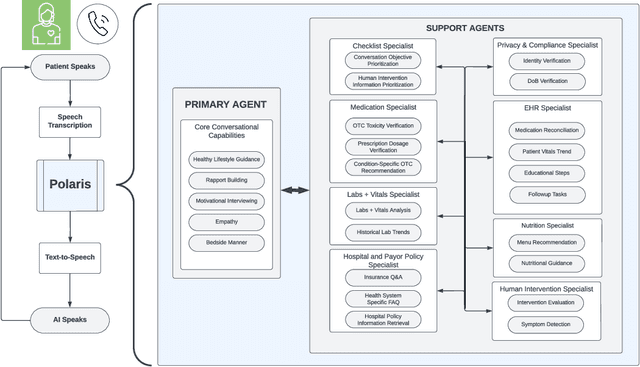
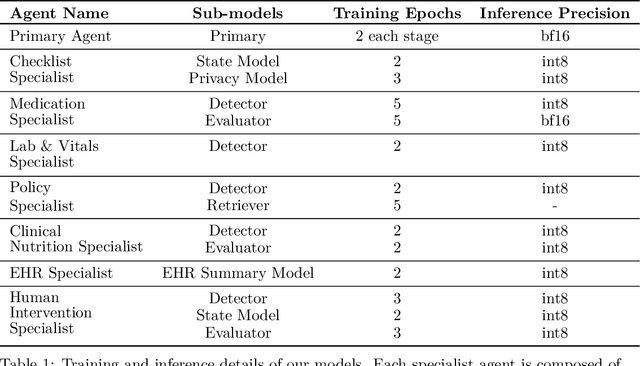
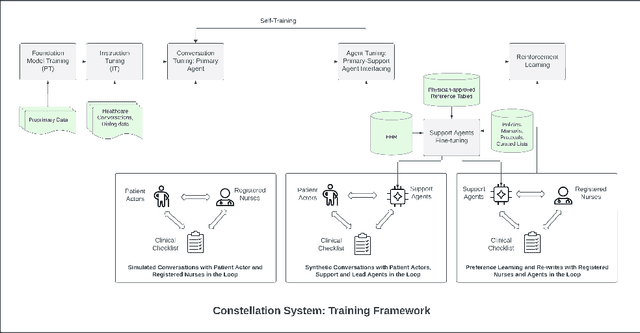
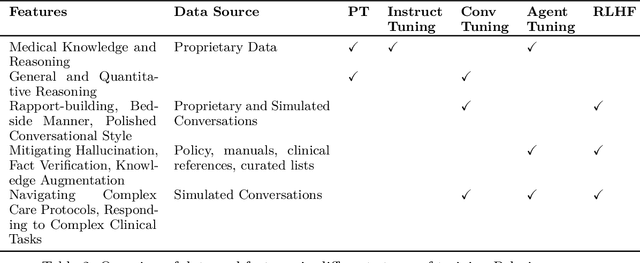
We develop Polaris, the first safety-focused LLM constellation for real-time patient-AI healthcare conversations. Unlike prior LLM works in healthcare focusing on tasks like question answering, our work specifically focuses on long multi-turn voice conversations. Our one-trillion parameter constellation system is composed of several multibillion parameter LLMs as co-operative agents: a stateful primary agent that focuses on driving an engaging conversation and several specialist support agents focused on healthcare tasks performed by nurses to increase safety and reduce hallucinations. We develop a sophisticated training protocol for iterative co-training of the agents that optimize for diverse objectives. We train our models on proprietary data, clinical care plans, healthcare regulatory documents, medical manuals, and other medical reasoning documents. We align our models to speak like medical professionals, using organic healthcare conversations and simulated ones between patient actors and experienced nurses. This allows our system to express unique capabilities such as rapport building, trust building, empathy and bedside manner. Finally, we present the first comprehensive clinician evaluation of an LLM system for healthcare. We recruited over 1100 U.S. licensed nurses and over 130 U.S. licensed physicians to perform end-to-end conversational evaluations of our system by posing as patients and rating the system on several measures. We demonstrate Polaris performs on par with human nurses on aggregate across dimensions such as medical safety, clinical readiness, conversational quality, and bedside manner. Additionally, we conduct a challenging task-based evaluation of the individual specialist support agents, where we demonstrate our LLM agents significantly outperform a much larger general-purpose LLM (GPT-4) as well as from its own medium-size class (LLaMA-2 70B).
Teaching Language Models to Hallucinate Less with Synthetic Tasks
Oct 10, 2023
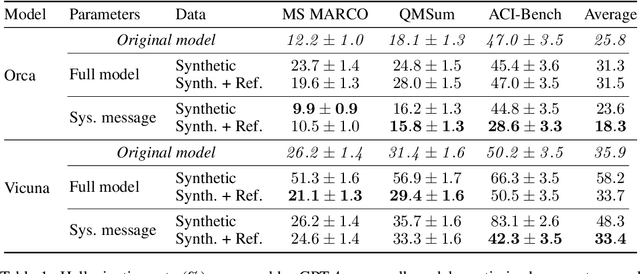
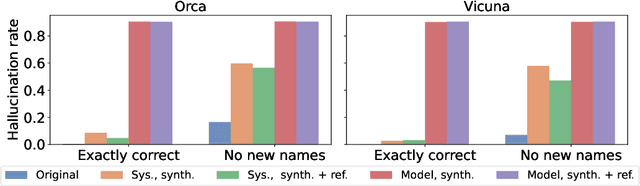
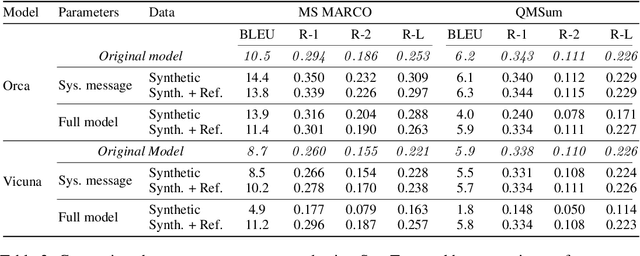
Large language models (LLMs) frequently hallucinate on abstractive summarization tasks such as document-based question-answering, meeting summarization, and clinical report generation, even though all necessary information is included in context. However, optimizing LLMs to hallucinate less on these tasks is challenging, as hallucination is hard to efficiently evaluate at each optimization step. In this work, we show that reducing hallucination on a synthetic task can also reduce hallucination on real-world downstream tasks. Our method, SynTra, first designs a synthetic task where hallucinations are easy to elicit and measure. It next optimizes the LLM's system message via prefix-tuning on the synthetic task, and finally transfers the system message to realistic, hard-to-optimize tasks. Across three realistic abstractive summarization tasks, SynTra reduces hallucination for two 13B-parameter LLMs using only a synthetic retrieval task for supervision. We also find that optimizing the system message rather than the model weights can be critical; fine-tuning the entire model on the synthetic task can counterintuitively increase hallucination. Overall, SynTra demonstrates that the extra flexibility of working with synthetic data can help mitigate undesired behaviors in practice.
Task-Based MoE for Multitask Multilingual Machine Translation
Sep 11, 2023Mixture-of-experts (MoE) architecture has been proven a powerful method for diverse tasks in training deep models in many applications. However, current MoE implementations are task agnostic, treating all tokens from different tasks in the same manner. In this work, we instead design a novel method that incorporates task information into MoE models at different granular levels with shared dynamic task-based adapters. Our experiments and analysis show the advantages of our approaches over the dense and canonical MoE models on multi-task multilingual machine translations. With task-specific adapters, our models can additionally generalize to new tasks efficiently.